
It is one of the most frustrating phone calls a homeowner can receive. You’ve identified a problem with your well water, invested thousands of dollars in a professional filtration system, and waited the required time for the system to cycle. You schedule a follow-up test to clear a real estate contingency or to simply ensure your family’s safety, only for the laboratory results to come back with another “Fail.”
In New Jersey, where water chemistry is heavily influenced by complex bedrock geology and industrial history, this scenario is surprisingly common. A treatment system is not a “magic wand” that permanently deletes contaminants; it is a mechanical and chemical process that requires precision, maintenance, and the right configuration. If your water is still failing after treatment, the cause usually falls into one of several specific categories, ranging from exhausted media to “re-contamination” within the home’s own plumbing.
1. Exhausted Filtration Media: The “Gas Tank” Analogy
Most water treatment systems—specifically those designed to remove arsenic, uranium, or iron—operate using “adsorption” or “ion exchange.” Inside the mineral tank is a specific type of media (like resin beads or iron-oxide granules) that has a finite capacity to attract and hold onto contaminants.
Think of your filtration media like a gas tank. Once all the “binding sites” on the media are filled with arsenic or radium molecules, the media is “exhausted.” At this point, the system begins to experience “breakthrough,” where the contaminants pass right through the tank and into your kitchen tap.
- The Fix: Many homeowners forget that specialized media must be replaced every 1 to 3 years depending on the “raw” water concentration. If you haven’t scheduled professional services to swap out your media, the system is essentially a hollow tank.
2. The Wrong Tool for the Job: Competitive Ions
Water chemistry is a balancing act. Sometimes, a system fails because other minerals in the water are “bullying” the contaminant you are trying to remove.
For example, if you are trying to remove Arsenic, but your water also has very high levels of Phosphate or Silica, those other ions may “compete” for the same spots on the filtration media. The media will fill up with the harmless phosphates first, leaving no room for the toxic arsenic.
In many Union and Somerset County locations, the presence of competing ions is a major reason why standard “off-the-shelf” filters fail. A system must be custom-designed based on a full chemical profile of the water, not just a single test result.
3. Bacterial Regrowth and “Biofilms” in the System
If your follow-up test failed for Total Coliform, the problem might not be the well—it might be the filter itself.
Water treatment systems, especially carbon blocks and softeners, provide a large, porous surface area where water moves slowly. If a small amount of bacteria enters the system, it can establish a “biofilm” inside the filter housing or the resin tank. Once a biofilm is established, the filter actually becomes a breeding ground for bacteria, contaminating the water as it passes through.
According to the Environmental Protection Agency (EPA), this is why UV (Ultraviolet) lights should always be the final stage of a treatment train. If you have an arsenic filter but no UV light, a minor bacterial spike can cause an overall system failure.
4. Plumbing Leaching: The Problem is in the Walls
As we often discuss on our blog, New Jersey’s “Raw Water Rule” requires testing the well before the filter. However, for a real estate closing, the “Treated” water must also pass.
If your treated water fails for Lead or Copper, the issue is almost never the well or the filter—it is your pipes. If you have a treatment system that successfully removes minerals but makes the water “aggressive” (low pH), that water will leach metals from your home’s copper pipes or lead solder. In this case, the filter is working perfectly, but it’s creating a new problem downstream. This is why many homes require an acid neutralizer in addition to other filtration.
5. Improper System “Regeneration” or Sizing
Water softeners and certain iron filters need to “regenerate” or backwash to clean the media. If the timer on your system is set incorrectly, or if the backwash flow rate isn’t strong enough to “fluff” the media and rinse away the trapped contaminants, the system will quickly lose effectiveness.
Additionally, flow rate is a major factor. Every filter has a maximum “gallons per minute” (GPM) rating. If you have a system designed for 5 GPM but you are running the dishwasher, the washing machine, and a shower simultaneously (10+ GPM), the water is moving too fast through the filter for the chemical reaction to occur. The water “slips” past the media, leading to a failed test result.
6. Failure to Bypass “Dead Ends” in the Plumbing
When a new system is installed to fix a bacterial or lead problem, the water inside the pipes throughout the rest of the house is still contaminated.
If the technician takes the follow-up sample from a guest bathroom sink that hasn’t been used in weeks, they are likely catching “old” water that was sitting in the pipes before the filter was installed. To avoid this, a thorough “whole-house flush” must be performed after any new system installation.
How to Ensure Your Next Test Passes
If you have already experienced a post-treatment failure, follow these steps to get back on track:
- Perform a “Diagnostic” Test: Test both the raw water and the treated water simultaneously. This tells you if the filter is doing anything or if it has completely failed.
- Check the “First-Draw” vs. “Flushed”: If lead is the problem, the issue is your plumbing. If bacteria is the problem, you may need a UV light or a system disinfection.
- Review the Flow Rate: Ensure your system is sized for the number of bathrooms and occupants in your home.
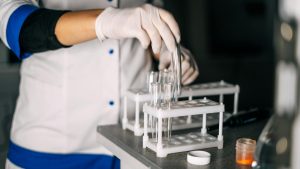
- Use a Certified Laboratory: At Olympian Well Water Testing, we help homeowners troubleshoot these failures. We don’t just give you a “Fail” result; we provide the data needed to show your water treatment professional exactly where the system is falling short.
Conclusion: Water Treatment is a Science, Not a Purchase
Buying a water filter is only the first step. Ensuring it continues to protect your family requires an understanding of how water chemistry shifts over time. A post-treatment failure is a sign that something in the “chain of safety” is broken—whether it’s the media, the system design, or the plumbing itself.
By staying proactive with regular maintenance and using high-precision testing, you can turn those frustrating failures into a success story. Don’t guess when it comes to your health; get the data you need to ensure your system is actually doing what it was designed to do.