
There is a deeply ingrained human instinct that tells us if something looks clean, it is safe. When we pour a glass of water from our kitchen tap and see a crystal-clear liquid free of sediment, cloudiness, or “floaties,” we naturally assume it is pure. In many homes across New Jersey, this assumption is the only thing standing between a family and a significant health risk.
The reality of groundwater science is far more complex than the “eye test” suggests. Many of the most dangerous substances found in private wells are completely invisible, odorless, and tasteless. From naturally occurring radioactive elements to modern industrial chemicals, the “clear water” coming out of your well can act as a delivery system for a variety of invisible threats. Understanding why clarity is not a guarantee of purity is the first step toward true water security.
The Dissolved Solid Paradox
To understand why clear water can be contaminated, we have to look at how water functions as a “universal solvent.” As rainwater trickles through the soil and into the aquifers of Northern New Jersey, it dissolves minerals and chemicals along the way.
When a substance is fully dissolved in water, it becomes part of the liquid’s molecular structure. Think of sugar stirred into hot tea; the sugar is still there, but you can no longer see it. In a well, this same process occurs with much more sinister components.
- Arsenic: Often called the “King of Poisons,” arsenic is a naturally occurring element in the bedrock of many NJ locations. It is a known carcinogen that is entirely invisible to the naked eye.
- Nitrates: Frequently originating from fertilizers or septic runoff, nitrates are colorless and odorless. They are particularly dangerous for infants, as they can interfere with the blood’s ability to carry oxygen.
- Volatile Organic Compounds (VOCs): These are man-made chemicals from fuels, solvents, and degreasers. While some have a faint chemical smell at high concentrations, they can be present at toxic levels in perfectly clear water.
The Invisible Threat: Radionuclides
One of the most concerning categories of “invisible” contaminants in the Garden State is radionuclides. Because much of the state sits on ancient granite and shale formations, radioactive elements like Uranium, Radium, and Radon are common.
These elements emit alpha, beta, or gamma radiation. They do not change the color of the water, nor do they impart a taste. A glass of water containing 50 µg/L of Uranium (well above the 30 µg/L safety limit) looks identical to a glass of distilled water. Without specialized services that utilize laboratory-grade radiological screening, a homeowner would never know they are consuming a radioactive substance every time they take a sip.
According to the United States Geological Survey (USGS), these contaminants are a widespread issue in the Northeast, yet they remain one of the least suspected problems by the average well owner because they lack any sensory “red flags.”
The Bacteria Deception: Total Coliform and E. coli
We often associate bacteria with “dirty” or stagnant water. However, microscopic pathogens can thrive in the cleanest-looking well water.
Bacteria like Total Coliform are “indicator organisms.” Their presence suggests that surface water or animal waste has found a path into the well. While coliform itself might not always make you sick, it signals that the well’s protective seals are compromised. If coliform can get in, so can E. coli or viruses.
Because bacteria are microscopic, they do not affect the clarity of the water unless the concentration is so high that it would be considered a public health emergency. This is why we emphasize on our blog that an annual bacteria test is non-negotiable, regardless of how great the water tastes.
Emerging Contaminants: The PFAS “Forever Chemicals”
In recent years, a new class of invisible contaminants has dominated the conversation around water safety: PFAS (per- and polyfluoroalkyl substances). These are man-made chemicals used in non-stick cookware, firefighting foam, and water-resistant fabrics.
PFAS are incredibly stable—they do not break down in the environment or the human body. Like arsenic, they are completely dissolved in the water column. You cannot see them, and you certainly cannot taste them. For a homeowner in an industrial or transit-heavy hub, these “forever chemicals” could be lurking in clear water, accumulating in the body over years of exposure.
The Environmental Protection Agency (EPA) has recently lowered the health advisory levels for these chemicals to near-zero, acknowledging that even microscopic amounts can be harmful. This further proves that the “naked eye” is an insufficient tool for water quality assessment.
Why Filtration Without Testing is a Risk
Many homeowners attempt to solve the “invisible contaminant” problem by installing a generic whole-house filter. While these systems are great for removing sediment and improving taste, they can create a dangerous “Filter Fallacy.”
If you have a filter that removes chlorine and sediment, your water will taste and look better than ever. However, if that filter isn’t specifically designed for arsenic, uranium, or PFAS, those harmful elements will pass right through. You might find yourself drinking more of the contaminated water because it “tastes so good,” unintentionally increasing your exposure.
A strategic approach to water safety involves testing the raw water first. Only then can you determine if you need specialized maintenance for a treatment system or a specific type of resin to catch the invisible threats.
The Role of Professional Laboratory Analysis
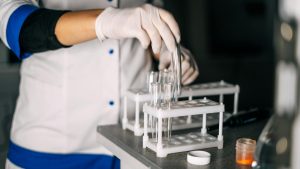
If the human senses are blind to these threats, how do we stay safe? The answer lies in the precision of a certified laboratory.
At Olympian Well Water Testing, we utilize equipment capable of detecting contaminants in parts-per-billion (ppb) or even parts-per-trillion (ppt). To put that into perspective, one part-per-trillion is equivalent to a single drop of water in 20 Olympic-sized swimming pools.
Our technicians look for:
- Heavy Metals: Lead, copper, and mercury.
- Radiologicals: Gross Alpha and Uranium.
- Chemicals: Nitrates, VOCs, and PFAS.
- Microbiology: Coliform and E. coli.
When Should You Test Your “Clear” Water?
Because you cannot rely on visual cues, you must rely on a schedule. We recommend professional testing in the following scenarios:
- Buying or Selling a Home: The New Jersey Private Well Testing Act (PWTA) mandates testing for many of these invisible threats during a sale.
- Annually for Bacteria and Nitrates: These can fluctuate with the seasons and heavy rainfall.
- Every 3–5 Years for Minerals and Chemicals: Elements like arsenic or uranium don’t disappear; they move slowly through the aquifer.
- After Major Local Construction: Vibrations and soil disturbances can open new pathways for contaminants to enter your well.
- If You Notice Staining: While the water is clear, the “after-effects” (like blue stains from copper or orange stains from iron) are clues that the chemistry is unbalanced.
If you are unsure of your well’s history, the best first step is to use a contact form to speak with a specialist who understands the specific geological risks of your New Jersey neighborhood.
Conclusion: Trust Data, Not Your Eyes
The “Eye Test” is for choosing fruit at the grocery store; it is not for determining the safety of your family’s drinking water. In a state with as much industrial history and geological diversity as New Jersey, clear water is often just a mask for a complex chemical profile.
By moving beyond the assumption that “clear equals clean,” you are taking a proactive step toward long-term health. Knowledge is the ultimate filter. When you have a laboratory report in your hand, you are no longer guessing—you are managing your home’s most vital resource with scientific certainty.