
What Fort Lee Sellers Should Know About the NJ PWTA and Private Wells
Selling a home in Fort Lee is often a fast-paced endeavor. With its proximity to the George Washington Bridge and its blend of urban convenience and suburban charm, properties here are highly coveted. However, for homeowners in the more residential or historic sections of the borough who rely on private wells, the path to the closing table includes a critical legal checkpoint: the New Jersey Private Well Testing Act (PWTA).
The PWTA isn’t just a suggestion—it is a mandatory consumer information law that can make or break a real estate transaction. If you are preparing to list your home, understanding these requirements early can prevent last-minute delays and protect your property’s value.
What is the NJ Private Well Testing Act?
Enacted in 2002, the NJ PWTA was designed to ensure that both buyers and sellers are fully informed about the quality of the drinking water before a property changes hands. Unlike municipal water, which is tested and treated by the city, private well water is the sole responsibility of the property owner.
The law requires that for any contract of sale for a property where the potable water supply is a private well, a comprehensive water test must be conducted. The results must be reviewed and signed off by both the buyer and the seller before the title can officially close.
Specific Requirements for Fort Lee and Bergen County
While certain contaminants are tested statewide, the NJDEP (Department of Environmental Protection) requires additional parameters based on local geology and industrial history. For a seller in a location like Fort Lee, your PWTA test suite will include:
- Bacteria: Total Coliform (and E. coli if coliform is present).
- Volatile Organic Compounds (VOCs): A list of 26 different compounds often linked to industrial runoff or old fuel tanks.
- Nitrates: Often a byproduct of fertilizers or septic system drainage.
- Lead: Testing is required for all real estate transactions.
- Arsenic: A naturally occurring mineral common in Northern New Jersey.
- PFAS Compounds: As of 2021, testing for PFOA, PFOS, and PFNA is mandatory.
- Uranium: This is a specific requirement for Bergen County and 11 other northern counties due to the regional rock formations.
Because Fort Lee sits atop the Palisades, the presence of radionuclides like Uranium is a legitimate concern. Ensuring your services include the full Bergen County panel is essential for legal compliance.
The Logistics: Who, When, and How?
One of the most common questions Fort Lee sellers ask is: “Who pays for this, and when do I do it?”
While the PWTA itself is silent on who bears the cost, in New Jersey, it is traditionally the seller’s responsibility to order and pay for the initial test. However, this is ultimately negotiable in the real estate contract.
The “Raw Water” Rule
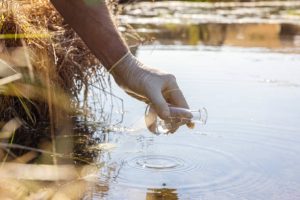
It is vital to understand that the PWTA requires the testing of untreated (raw) water. Even if you have a sophisticated whole-home filtration system, the sample must be taken before the water enters any treatment device. This gives the buyer a clear picture of the actual condition of the aquifer. If your well fails the test, but your filtered water is clean, it demonstrates that your current maintenance strategy is working—but the raw water failure must still be disclosed.
Timing the Test
Laboratory results for a full PWTA panel typically take 10 to 15 business days. This is because tests for things like Gross Alpha (radiologicals) require a specific “settling” time in the lab. Smart sellers in Fort Lee schedule their testing as soon as the home is under contract—or even before listing—to ensure no surprises pop up a week before closing.
Common “Fails” for Fort Lee Sellers
In our experience at Olympian Well Water Testing, there are three common areas where Fort Lee wells tend to hit a snag during a PWTA inspection:
- Coliform Bacteria: Often introduced by a loose well cap or recent heavy rains.
- Arsenic or Uranium: These are naturally occurring in the bedrock of the Palisades. They are invisible and odorless but require specific filtration to remediate.
- Lead: While often coming from internal plumbing rather than the well itself, a high lead result must be addressed.
If a test comes back with an exceedance (a “fail”), the sale is not legally barred from proceeding, but the results must be disclosed. Usually, the buyer will request a credit or ask the seller to install a remediation system as a condition of the sale.
The Seller’s Strategy: Pre-Listing Testing
While the law requires a test during the transaction, many savvy Fort Lee residents are choosing to perform a “pre-listing” test. By consulting our blog and ordering a test before the home even hits the market, you gain several advantages:
- No Surprises: You won’t be blindsided by a $3,000 remediation requirement while you’re trying to pack your boxes.
- Buyer Confidence: Providing a clean water report at an open house is a major selling point in a market where people are increasingly health-conscious.
- Negotiating Power: If you know your water is perfect, you have one less thing for a buyer to use as a price-haggling tool.
Legal Obligations and Disclosure
Under New Jersey law, once you have a water test result in your hand, it becomes a material fact. If you perform a test and it fails, you must disclose those results to any potential buyer. This is why working with a professional who can explain the results—and offer solutions—is so important.
For more information on the specific legal statutes, you can visit the New Jersey Realtors® guide on the PWTA, which outlines how these reports impact the standard sales contract.
Protecting Your Transaction
The Fort Lee real estate market moves fast, and the last thing any seller wants is for a “Total Coliform: Present” result to derail a million-dollar closing. By understanding the NJ PWTA requirements and treating your well as a vital part of your home’s infrastructure, you ensure a smoother transition for yourself and the future family moving in.
If you have questions about the specific parameters for Bergen County or need to schedule a certified technician for your upcoming sale, reaching out through our contact page is the first step toward a compliant and successful closing.
Would you like me to create a printable “Seller’s Well Water Prep Guide” that you can give to your real estate agent to ensure your well is ready for the PWTA inspection?