
When you turn on the kitchen faucet in a Newark home, you expect the water to be pristine, especially if it appears crystal clear. For one local homeowner, that clarity was deceptive. During a routine property assessment, their private well water—which looked perfectly fine in a glass—returned laboratory results that failed for both iron and odor.
This scenario is more common than many residents realize. In the complex geology of the Newark Basin, “clear-water iron” and microbial byproducts often hide in plain sight. Understanding why clear water can still fail a test is the first step in ensuring your home’s water is truly as clean as it looks.
The Mystery of “Clear-Water Iron”
The most confusing part of this Newark case was the visual evidence. If there is iron in the water, shouldn’t it be orange or rusty?
Not necessarily. Iron in well water typically exists in two primary forms:
- Ferric Iron: This is “red-water iron.” It has already been exposed to oxygen, creating visible rust particles that make the water look cloudy or orange.
- Ferrous Iron: This is “clear-water iron.” It is completely dissolved in the water. When it comes out of the tap, it is invisible to the naked eye.
However, as soon as ferrous iron is exposed to the air—such as in a toilet tank or a glass sitting on a counter—it oxidizes and turns into ferric iron. This is why a Newark resident might have clear water at the tap but notice stubborn orange stains in their shower or dishwasher. Even if you can’t see it initially, a professional services provider can detect these dissolved levels through precise chemical analysis.
Why the Odor? The Role of Iron Bacteria
In this specific Newark incident, the iron failure was accompanied by a distinct, unpleasant odor. While many people associate “well water smell” with the rotten-egg scent of hydrogen sulfide, iron-related odors are different. They are often described as earthy, musty, or even smelling like “swamp water.”
This odor is frequently caused by iron bacteria. These are naturally occurring organisms that thrive in iron-rich, low-oxygen environments like the aquifers beneath Newark. They don’t necessarily cause disease, but they feed on the dissolved iron and create a slimy, smelly biofilm inside your pipes and well casing.
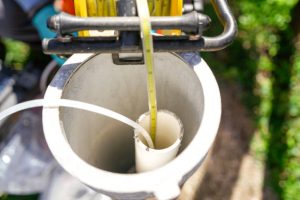
[Diagram of a well casing showing biofilm buildup on the interior walls]
When these bacteria are present, they can interfere with your well’s maintenance and efficiency. They can clog pump intakes and reduce water pressure, turning a simple aesthetic issue into a mechanical one.
The Local Landscape: Newark’s Industrial and Geologic History
Newark is a city with a rich industrial legacy, and its groundwater reflects that history. The Newark Basin consists largely of red sedimentary rock and shale, which are naturally high in iron and manganese.
When heavy rains hit this location, the water table rises and interacts with these mineral-rich layers, pulling more dissolved iron into the private wells scattered throughout the North and West Wards. Furthermore, in an urban-industrial setting, the presence of organic matter in the soil can accelerate the growth of iron bacteria. This makes Newark wells particularly susceptible to the “clear-water iron” trap.
The Risks of Ignoring “Aesthetic” Failures
Under the NJ Private Well Testing Act (PWTA), iron is considered a “secondary” or aesthetic contaminant. This means it isn’t considered a direct threat to human health in the same way that lead or arsenic are. However, for a homeowner, an iron failure is far from a minor issue.
- Plumbing Damage: Iron buildup acts like “arteriosclerosis” for your home’s plumbing. It narrows the diameter of your pipes and destroys the internal components of water heaters and appliances.
- Staining: It ruins laundry and leaves permanent etchings on expensive stone tiles and porcelain fixtures.
- Taste and Nutrition: While the body needs iron, “dissolved” iron in water has a harsh metallic taste that ruins the flavor of food, tea, and coffee.
Because these issues are progressive, staying updated via a local blog is essential for homeowners who want to catch mineral imbalances before they require a full repiping of the house.
How to Test for Invisible Iron
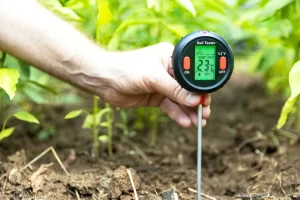
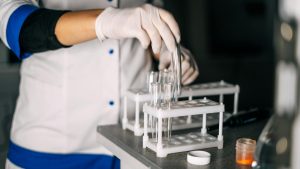
If your Newark water looks clear but you suspect an iron problem, a standard DIY “dip strip” is rarely enough. A professional laboratory test is required to differentiate between total iron, dissolved iron, and the presence of bacteria.
At Olympian Well Water Testing, we look at the “Total Iron” count. According to the Environmental Protection Agency (EPA), the recommended upper limit for iron is 0.3 mg/L. Anything above this level will cause staining and odor, regardless of whether the water looks clear when it first hits the glass.
Solutions for the Newark Homeowner
The Newark well that failed was eventually remediated through a two-step process:
- Shock Chlorination: To kill the iron bacteria and eliminate the “swampy” odor.
- Oxidizing Filtration: A system that “forces” the clear-water iron to become visible (oxidize) so it can be trapped and filtered out before it enters the home’s plumbing.
Every well is different, and the right solution depends on your specific pH levels and water hardness. If you are experiencing similar issues, reaching out through a contact page is the best way to get a customized treatment plan.
Conclusion: Don’t Trust the Eye Test
The case of the Newark well that failed for iron and odor serves as a vital reminder: clarity is not a guarantee of purity. Invisible, dissolved minerals and microbial colonies can thrive in water that looks perfectly safe to drink.
For Newark residents, being a “well owner” means being a “water manager.” By understanding the unique mineral profile of the Newark Basin and prioritizing professional laboratory testing, you can protect your plumbing, your property value, and your quality of life. The next time you pour a glass of water, remember that what you don’t see matters just as much as what you do.