
In the competitive real estate market of Elizabeth, New Jersey, the path from “For Sale” to “Closed” is often paved with paperwork, inspections, and the high-stakes requirements of the New Jersey Private Well Testing Act (PWTA). For many homeowners, the process seems straightforward: test the water, and if there’s a problem, install a filter.
However, a frustrating trend has emerged among local sellers. Many are discovering that even after spending thousands of dollars on sophisticated filtration systems, their water is still failing follow-up laboratory tests. This phenomenon has led to a surge in retesting and a deeper investigation into why traditional “fixes” are falling short in the Elizabeth area.
The Frustration of the “False Fix”
Imagine this: You are a seller in Elizabeth with a buyer ready to sign. The initial PWTA test shows an exceedance of iron, manganese, or even volatile organic compounds (VOCs). You dutifully call a contractor, install a high-end filtration system, and wait for the “all-clear” so you can move to the closing table.
Instead, the results come back: FAILED.
This scenario is becoming increasingly common. Sellers are finding themselves stuck in a loop of installation and retesting, often while their real estate deal hangs by a thread. The reason usually boils down to a fundamental misunderstanding of water chemistry or the specific industrial-urban challenges unique to this location.
Why Filtration Systems Fail the Second Test
There are several technical reasons why a filter might not deliver the results promised on the box, particularly in the complex groundwater environment of Union County.
1. Improper System Sizing and Flow Rates Filtration is a game of “contact time.” To remove contaminants like arsenic or PFAS, the water must spend a specific amount of time in contact with the filter media (such as carbon or resin). If the system is too small for the home’s flow rate, or if the water pressure is too high, the water “shortcuts” through the filter. The result? Contaminants remain in the glass, and the lab test fails again.
2. The Chemistry “Shift” Water is a solvent. When you remove one mineral, you often change the pH or the electrical conductivity of the water. In Elizabeth, where groundwater can be slightly acidic, some filters inadvertently make the water more corrosive. This leads to the leaching of lead or copper from the home’s own pipes after the water has passed through the filter. This is why specialized services often involve testing both before and after the treatment system to pinpoint exactly where the failure is occurring.
3. Media Saturation and “Dumping” If a system was installed without a recent maintenance check, the filter media may have reached its capacity. In some cases, a saturated filter can actually “dump” accumulated contaminants back into the water in a single burst, leading to a test result that is actually worse than the raw water from the well.
The Elizabeth Context: Urban Groundwater Complexity
Elizabeth isn’t just any suburb; it’s an urban center with a deep industrial history. The groundwater here is influenced by decades of manufacturing, high-density living, and proximity to major transit corridors.
Standard “off-the-shelf” filtration systems are often designed for rural wells where the primary concern is simple bacteria or hardness. In Elizabeth, sellers are often battling “Forever Chemicals” (PFAS), VOCs from old industrial sites, and high levels of naturally occurring minerals. According to the NJ Department of Environmental Protection (NJDEP), the requirements for Bergen and Union counties are among the most stringent in the country because the risks are higher. A “one-size-fits-all” filter rarely works here.
The Legal Stakes: PWTA Compliance and Disclosure
For a seller, a failed test isn’t just a nuisance—it’s a legal hurdle. The PWTA requires that the buyer and seller exchange the actual laboratory results. If a seller installs a filter but the water still fails, that failure must be disclosed.
This is why many sellers are now turning to professional retesting before they even show the home to a second buyer. By working with Olympian Well Water Testing, sellers can get a definitive answer on whether their system is actually performing to state standards. Knowledge is power at the negotiating table; knowing your system works (and having the lab work to prove it) prevents a buyer from demanding a $5,000 credit for a “faulty” well.
Common Contaminants Triggering Retests in Elizabeth
When we look at the data from our blog and local field reports, a few specific contaminants are repeatedly causing post-filtration failures in Elizabeth:
- Gross Alpha/Radiologicals: These are notoriously difficult to filter and often require specific types of ion exchange or reverse osmosis systems that many standard “whole house” filters lack.
- PFAS (PFOA/PFOS): These require high-grade Granular Activated Carbon (GAC). If the carbon is the wrong grade or the water moves too fast, the “Forever Chemicals” slip right through.
- Nitrates: Often requiring specialized resin, nitrates can “bleed” through a standard water softener, leading to a failed PWTA report.
The Solution: A Diagnostic Approach to Retesting
Why are Elizabeth sellers retesting? Because they’ve realized that a “pass/fail” result doesn’t tell them how to fix the problem.
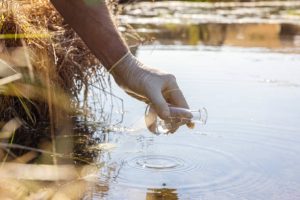
A diagnostic retest involves taking samples from multiple points in the system:
- At the Well (Raw Water): To see exactly what is coming out of the ground.
- After the Filter: To see if the system is doing its job.
- At the Furthest Tap: To see if the plumbing inside the house is adding new contaminants (like lead).
This “surgical” approach to testing ensures that the seller isn’t just guessing. It allows them to go back to their filtration contractor with proof, or to adjust their system to meet the specific needs of Elizabeth’s water chemistry.
Steps for Sellers to Avoid the “Filter Failure” Loop
If you are preparing to sell your home in Elizabeth, follow these steps to ensure you only have to test once:
- Don’t DIY the Solution: Home-store filters are rarely sufficient for NJ PWTA standards. Consult a professional who understands the state’s Maximum Contaminant Levels (MCLs).
- Demand a Post-Installation Lab Test: Don’t take the installer’s word for it. Ensure a certified lab confirms the water is safe.
- Check the “First Draw”: Since lead and copper often come from the pipes, make sure your retest accounts for water that has been sitting in the lines, as per the Environmental Protection Agency (EPA) guidelines.
- Use Local Experts: Reach out through a contact form to find a tester who knows the Elizabeth “vibe.” Local technicians are familiar with the specific plumes and mineral pockets that define Union County groundwater.
Conclusion: Protecting the Deal
In the world of Elizabeth real estate, a private well can be a blessing or a curse. Sellers who are finding success aren’t the ones who ignore the problems, but the ones who tackle them with scientific precision.
Retesting after a “failed” filtration attempt is becoming the new standard because it provides the only thing that can save a closing: certainty. When a lab report finally comes back “Non-Detect,” it isn’t just a piece of paper—it’s the green light to move on to your next chapter.
Don’t let a poorly configured filter stand between you and your home sale. Stay informed, stay proactive, and always verify your water quality with a professional laboratory.
Would you like me to review your recent failed test results and help you determine which specific filtration adjustments might be needed to pass your next NJ PWTA inspection?